
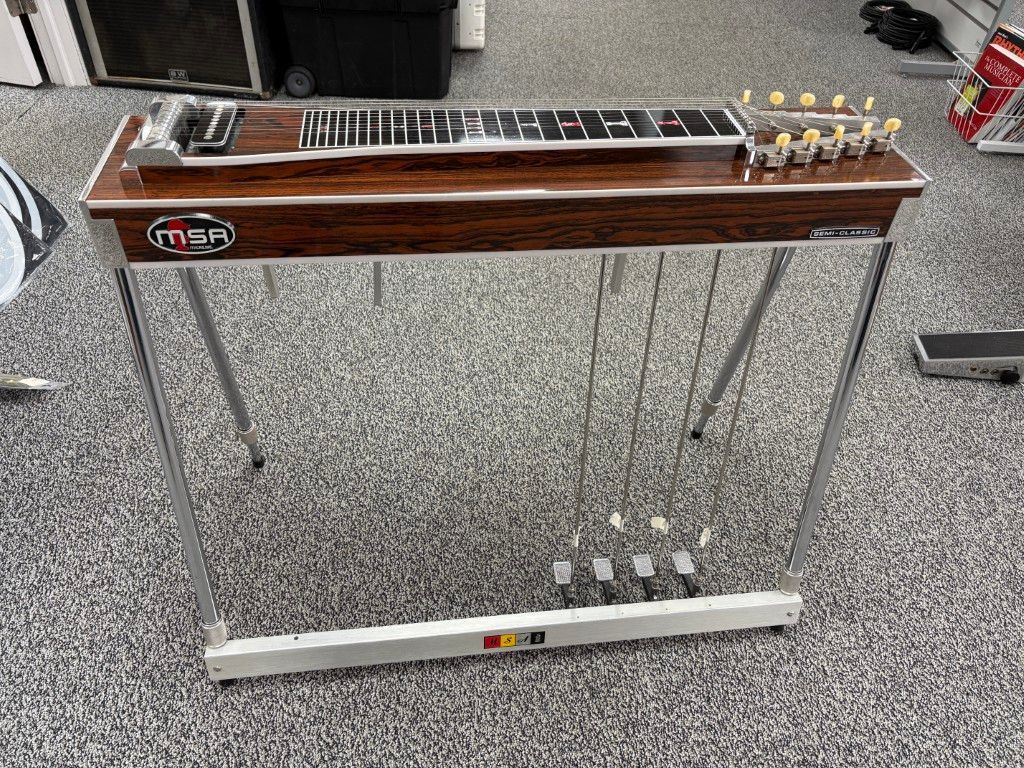
MSA Semi Classic 10-String Pedal Steel Guitar 1970s
1970s-era MSA Semi Classic 10-string pedal steel guitar. ***Please note that this is not shippable…local pickup only.***
This instrument is a consignment piece, and the following is his description, including customization and other maintenance:
"This is a vintage circa 1970s MSA Semi Classic 10 string pedal steel in woodgrain formica finish. It has an “All PULL, DOUBLE RAISE DOUBLE LOWER” Mechanism. The tuning machines are Kluson. It is in excellent cosmetic and playing condition. It was rebuilt about 10 years ago (new nylon washers in the changer, etc.). It has also been “maxxed out” (upgraded) with additional knee lever and pedal, and upgrades/modifications to the mechanism (details below). The Copedent (chord pedal arrangement) is pretty much traditional Emmons type. The three original pedals are (left to right): (A Raises Bs to C#) (B Raises G#s to A) and (C raises 4th string E to F# and 5th string B to C#). The four knee levers are set up as follows: (RNR lowers Es to D#) (RNL Raises Es to F) (LNR Lowers D#s to D) (LNL Raises F#s to G)
Details of upgrades/changes:
- 1. A fourth pedal has been added in the “0” position (to the left of the A,B,C Pedals). This is currently set up to Lower the G#s to G.
- 2. A vertical knee lever has been added for the left knee. Note: the vertical knee lever itself and its mounting bracket were home fabricated. ALL CROSSRODS, BELLCRANKS, PULL RODS, ETC. ARE ORININAL MSA. The vertical knee is normally used in combination with the “A” pedal to produce C naturals on the “B” strings. Two “half stop” adjusting screws have been added to the changer (see pic) for the two “B” strings. This allows the vertical pedal to be used alone to produce “Bbs” on the “B” strings. Please note, the the vertical knee lever extends well past the bottom of the cabinet so, needs to be unscrewed and removed to fit in a case. Also, the LKL knee lever can’t fold down with the vertical knee lever installed (see pic). Removal/installing of the vertical lever involves removing two screws (see pic). The parts are small and it is a little fiddly till you get the hang of it.
- 3. An original Semi Classic had the tuning end plate only “drilled out” for a limited number of changes, probably just for the 3 pedals and the two “E” knee levers vs. the 40 holes (4 per sting) an MSA Classic has. A prior owner cut out the tuning “window” at the “changer” end to allow access to all 40 possible pull rod locations. However, that left nothing to hold the pull rods / changer “fingers” in place horizontally (laterally). So, I fabricated a new “stop plate” which was wider than the original and has channels cut in it to hold the pull rods / changer “fingers” in their correct horizontal positions (see pic).
- 4. The original ¼” aluminum back plate “cover” that holds the crossbars in place was gone so I replaced it with a 1/8” polished aluminum plate (a bit lighter).
So, after those changes, this instrument is pretty much he same as a “Classic” model, just a little smaller and lighter (good thing). Like all semi classics, it has Kluson tuners instead of Grovers.
- 5. The MSAs of the era did not have adjustable changer return springs, and in fact came with what some consider overly heavy springs (needing more force on some of the pedal/lever pulls). I changed out the original heavy springs (not included) for lighter one’s as some MSA owners like to do. Additionally, I added a set of adjustable “helper springs” (see pic) to make the pedal/lever action still easier. This necessitated creating a small (cut/bend/1/16” hole drilled) at the bottom corner of each changer finger to accommodate the springs. They are anchored to a bar running across the body about 6” from the changer. The helper spring setup is easily removable in a few minutes if you don’t care for it. BTW, the instrument currently has EXTRA LIGHT STRINGS on it. It’s been set up to have a very light pedal / lever action. You can, of course, go heavier on the strings but anytime you change guages, you’ll need to “retune” the mechanism. If you are reading this listing, you probably already know all of this. If you do go to medium or heavy strings, you might need to use heavier return springs for some of the changes. I did find four of the original springs which are included with the extra parts. If you need more, they are inexpensive and a good pedal steel shop should have them.
- 6. One complaint some people have about MSAs is that they have a dark mellow sound compared with some other steels which are “twangier.” I replaced the original “Supersustain” pickup (NOT INCLUDED) with a Wallace True Tone single coil pickup and that brightened up the tone considerably.
The MSA comes with a “steel bar,” set of finger picks, a canvas bag for the legs and pedal rods, book, Chromatic tuner, a 3/16 tuning wrench for the pull-rod nuts, several “Allen” wrenches for the more common mechanism adjustments, a wrench for adjusting the “B” string “split” screw adjustment, and some misc, extra parts (tuning nuts, 1 bell crank, 1 cross-rod stop, 1 pull rod, rod barrels, springs, etc.) While I have included the more frequently used allen wrenches, I would suggest getting a good quality set of SAE/US (NOT metric) allen wrenches before digging into the mechanism. A VOLUME PEDAL IS NOT INCLUDED, NOR IS A CASE.
Any down sides, yes, of course, every instrument has a few. The extra solid construction makes the instrument relatively heavy as pedal steels go, and in fact, it might not be the best choice for someone whose priorities are fast setup and light weight. You can set up the copedent any way you like. However, changes to this mechanism may require a little more time and patience than on some more modern steels.
This MSA does not come with a case. An anvil flight case large enough to hold the instrument and accessories is available for purchase separately. It would be nice if it was a a bit deeper (higher) but the instrument, with some padding, will fit in it. The case’s original foam padding has deteriorated over the years and is gone. So you would need some towels or a blanket to protect the instrument in the case.
A Volume pedal is also NOT INCLUDED. But a Goodrich pedal with pedal steel mounting bracket is also available for purchase separately.
MSA doesn’t quite have the cache’ of Emmons or Sho-Bud so you’ll be getting a lot of instrument for your money with this pedal steel. The MSA semi classic is an exceptionally well made instrument. They were made to exacting standards with extremely high quality aluminum. Their machining was some of the best in the industry. Holds tuning very well and is built like a tank. There are a lot of them still out there attesting to their longevity. And, MSA is still in business today. All that being said, this is a vintage instrument at 40+ years of age, and as such, does not come with any warranty. I’ve tried my best cover everything and to give an accurate and honest description. Happy to answer any questions you may have."